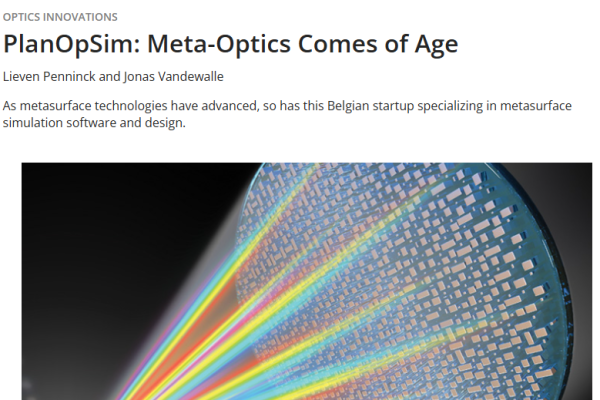
CEO Lieven Penninck speaks to Keltie’s Monica Patel and Emily Weal and shares how their AI-powered simulation software blends physics, accuracy, and manufacturability. All helping companies design smarter, smaller, and more efficient optical components.
From automotive optics to manufacturer-ready PDKs, PlanOpSim is removing traditional bottlenecks and making metasurfaces ready for the mass market.
 Here is the details of the interview:
We spoke with CEO and co-founder Lieven Penninck about the origins of PlanOpSim, how artificial intelligence is reshaping photonics development, and why simulation software must sit at the intersection of physics, accuracy, and manufacturability.
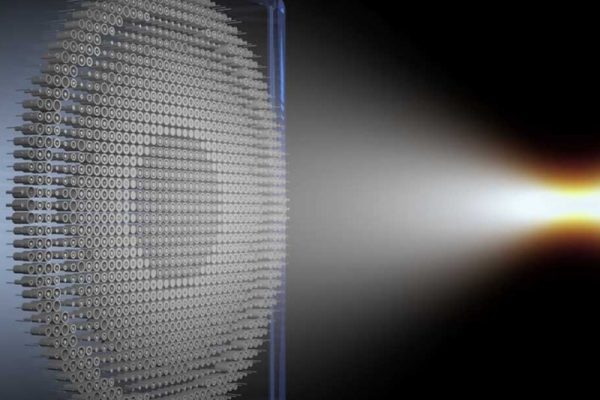
Planar optics and metalenses have moved rapidly from academic curiosities to practical technologies powering consumer devices, vehicles, and sensors. At the centre of this transformation stands PlanOpSim, a Belgian startup developing advanced computer-aided design (CAD) tools to make metasurface innovation scalable and manufacturable.
From Lab Curiosity to Industry Platform
Founded in 2019, PlanOpSim’s genesis came from Lieven’s insight while working on OLED display modelling. While academic researchers were experimenting with metamaterials, their workflows were fragmented, relying on disconnected simulations.
“I realized there was already a whole chain of methods that could be tied together in a workflow,†Lieven explained. “That could lead to a much more efficient design process.†Supported by the Flemish Innovation Fund and IMEC, Lieven built a prototype that laid the foundation for PlanOpSim’s integrated software.
In just a few years, metasurfaces have gone from lab experiments to mainstream adoption. As Lieven notes, “There are meta surfaces in iPad Pros—without consumers even realizing it.â€
The PlanOpSim Software Workflow
Designing nanostructured materials demands solving Maxwell’s equations at different scales—from nanoscale features to full system-level optics. PlanOpSim has built a platform that allows designers to move seamlessly between:
- Nanoscale simulations for individual structures;
- Component-level simulations for optical modules; and
- System-level modelling for complete devices such as displays or sensors.
Crucially, the software outputs not just designs but manufacturing-ready files, including tolerance analysis and compatibility with specific fabrication processes. By integrating design and production, PlanOpSim ensures components are not only optimized but also manufacturable at scale.
The Role of AI in Metasurface Design
Optimization has always been central to numerical design, and PlanOpSim leverages both algorithmic methods and AI-driven techniques. But Lieven notes that expectations for AI in physics-heavy domains are being recalibrated.
“The strength lies in making very specific solvers rather than chasing general intelligence,†he explained. “For example, if we can make a solver that works extremely well for industrially relevant cases like fused silica, that already solves many real-world problems without needing something universally applicable.â€
Areas where AI is increasingly useful include:
- Inverse design of nanostructures;
- Accelerating repetitive calculations with surrogate solvers;
- Improving lab alignment and manufacturing reproducibility; and
- Using LLMs to assist users in design workflows with real-time feedback.
Tackling Software–Materials Integration
Working at the boundary of advanced software and materials brings unique challenges. Unlike many commercial software fields, where performance increases by using more hardware, physics simulations for optics and materials demand extreme algorithmic precision.
Lieven highlights that developers joining PlanOpSim often need to recalibrate expectations: “This is still like the early days of computing, where every line of code must be optimized for speed and memory. Incremental hardware gains don’t solve the bottleneck—mathematical breakthroughs do.â€
Case Studies: From Automotive Optics to PDKs
PlanOpSim’s platform has already been applied to challenging real-world design problems:
- Automotive optics efficiency: A customer project replaced inefficient conventional projection lenses with a compact metasurface design. The result was a projection optic just a few centimetres in size—five times more power-efficient, compact enough for integration into cars, and manufacturable directly from PlanOpSim’s design files.
- Reducing R&D timelines with PDKs: PlanOpSim was the first to introduce Process Design Kits (PDKs) into the metasurface domain. These manufacturer-provided “building block†libraries bypass two major bottlenecks: complex nanostructure design and manufacturability verification. By ensuring compliance with fabrication processes upfront, PDKs dramatically shorten the path from concept to prototype—mirroring how PDKs transformed electronics and photonic integrated circuits.
Intellectual Property and Security Considerations
Intellectual property strategy is top of mind for PlanOpSim’s customers. While cloud-based simulation offers scalability, many customers—particularly in defence or high-security sectors—require standalone, air-gapped solutions.
PlanOpSim built on-premise versions to meet these needs. Additionally, customer designs remain encrypted and inaccessible to PlanOpSim itself. In service projects, customers have the option to receive an unrestricted license to the design IP. This structure allows companies to innovate quickly and securely.
Looking Ahead: Bigger Simulations, Better Surrogates
What excites Lieven most about the next stage of computational optics? Two areas stand out:
- Surrogate solvers: AI-driven approximations that accelerate complex calculations without sacrificing accuracy; and
- Scaling simulations: New distributed methods that expand feasible calculation sizes from tens of micrometres to much larger areas, opening possibilities for system-level metasurface design.
“We’re at the point where traditional bottlenecks are starting to crumble,†Lieven concludes. “The combination of algorithmic breakthroughs, AI acceleration, and manufacturability integration will bring metasurfaces from niche innovation into mass-market devices.â€